Module 01 / CARDIAC
HeartX
LIVE FLAGSHIPThirty cardiac metrics across eight regions, measured in place from one non-contrast CT.
01 · The single-patient journey
The single-patient journey.
One patient, screen by screen: the 3D heart with all 28 structures shown and hidden by chamber, the CT viewer with its segmentation overlay, then the measurement panels — body composition, multi-compartment fat, the AHA 17-segment bullseye, myocardial texture, organ volumes, liver density — each value carrying its percentile within the cohort. It ends on the patients whose radiomic profile sits closest.
02 · The catalogue
Every cardiac metric, region by region.
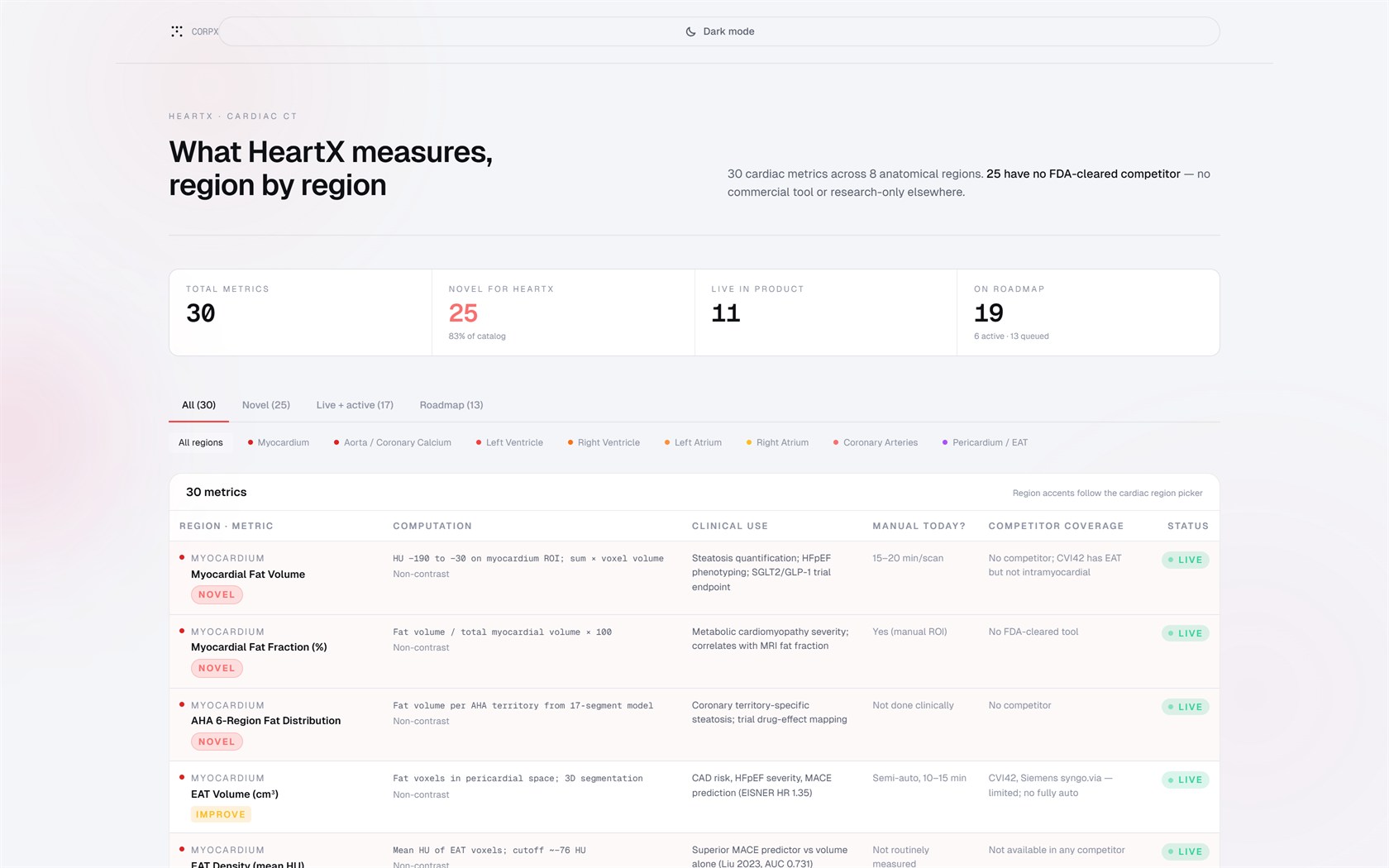
The catalogue is the module’s spec sheet, and it says where each metric stands: eleven run in the product today, nineteen are specified and queued. This is the whole list, including the parts that are not built yet.
30
metrics
8
anatomical regions
11
live in product
19
on roadmap
03 · What it replaces
What these measurements cost by hand.
Straight from the catalogue’s “manual today?” column — what it takes to produce the same number without the module.
Measurement
By hand today
What that means
Myocardial fat volume
15–20 min
Per scan, by hand.
Myocardial fat fraction
Manual ROI
Or an MRI appointment instead.
AHA 6-region fat distribution
Not done
Not performed clinically at all today.
EAT volume
10–15 min
Semi-automatic, per scan.
04 · The analytics
Three ways in to the same values.
Unretouched captures of the running platform. HeartX carries its own accent inside the product — violet is CorpX, each module owns its hue.
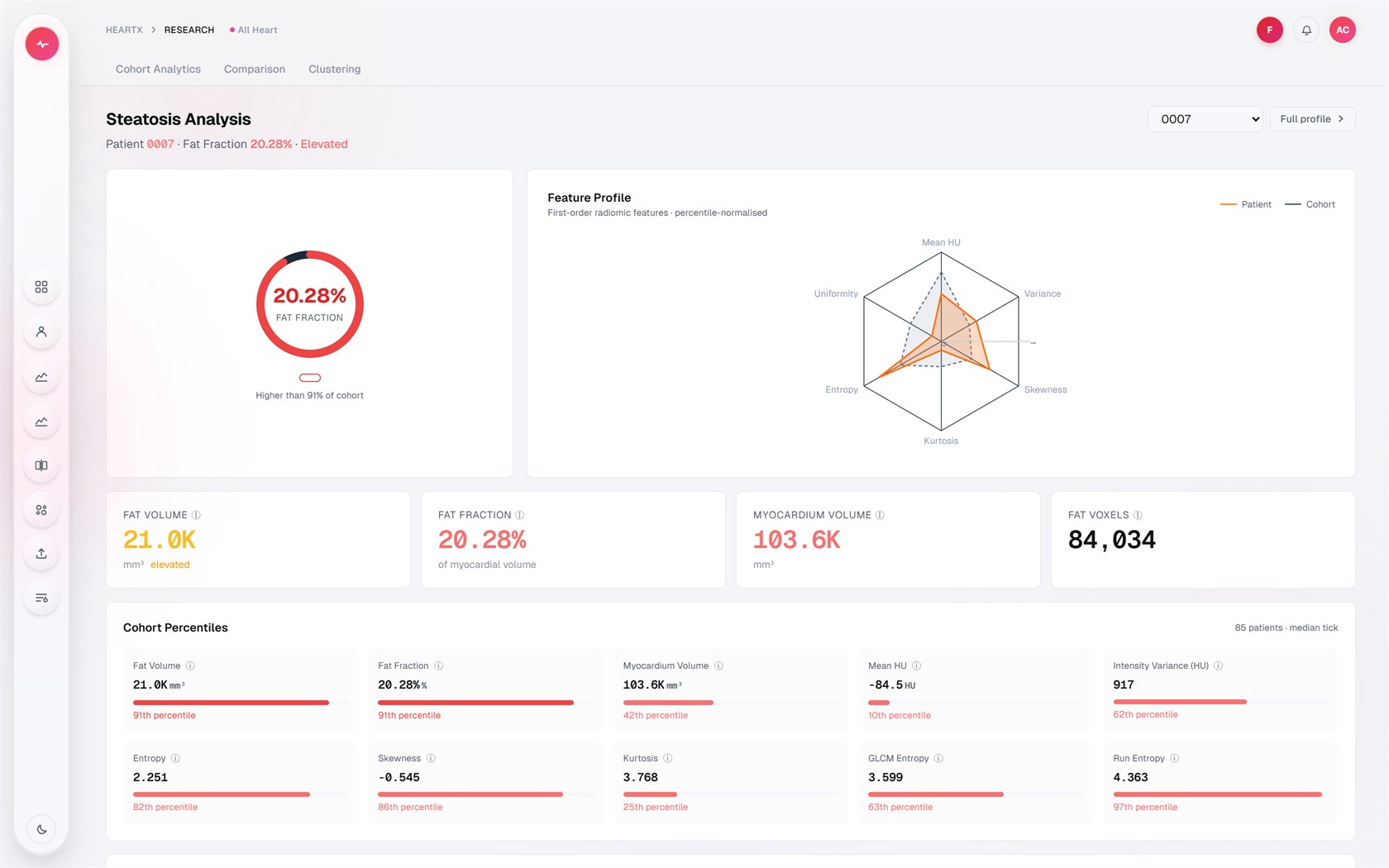
Descriptive analytics — quantification and visualisation, not diagnosis.
05 · The endpoint package
The measurements your trial asks for.
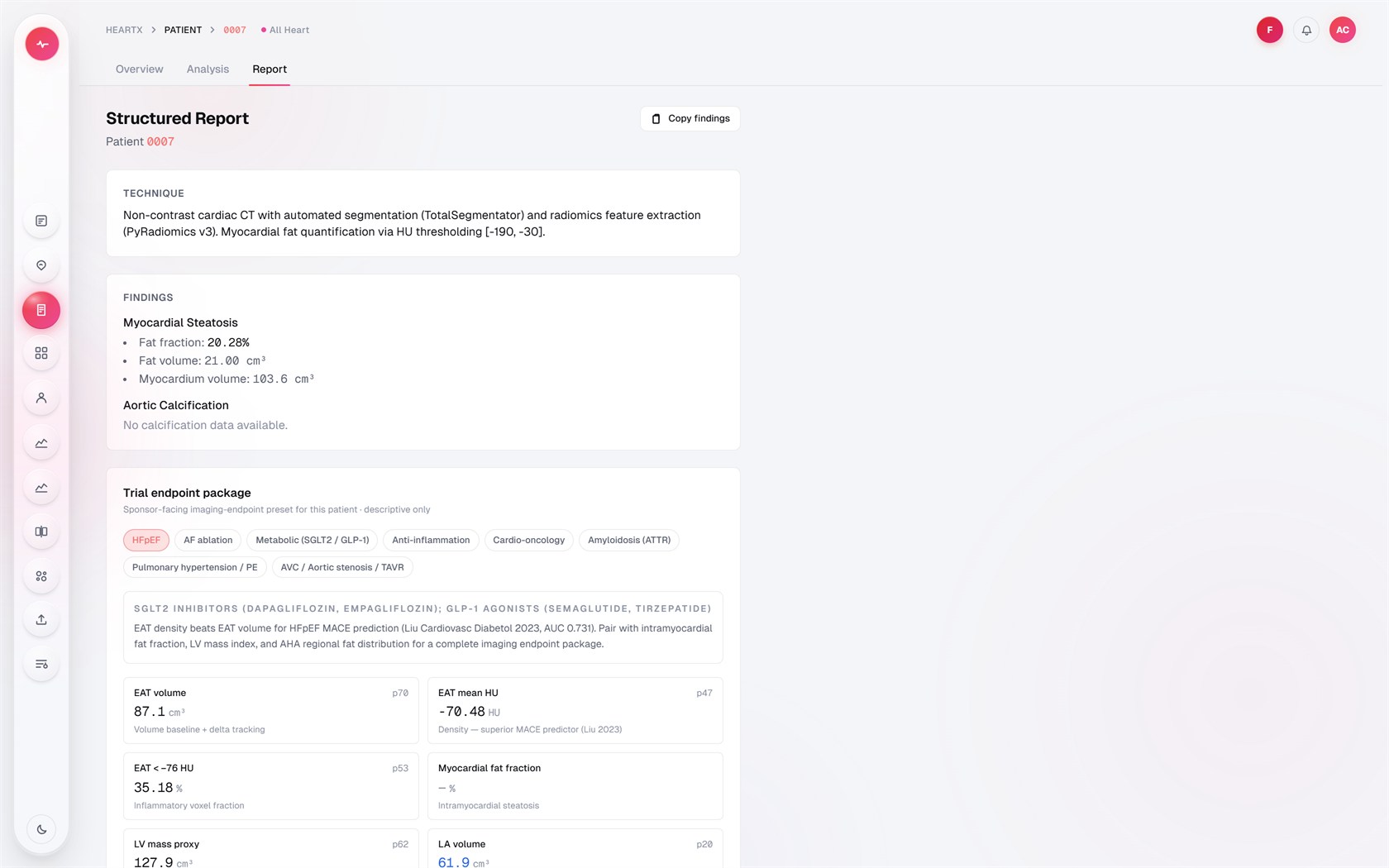
A trial does not want thirty metrics; it wants the handful its protocol names. The report ships with endpoint presets — HFpEF, AF ablation, metabolic (SGLT2 / GLP-1), anti-inflammation, cardio-oncology, amyloidosis (ATTR), pulmonary hypertension and PE, AVC / aortic stenosis / TAVR — each measurement carrying its cohort percentile and the paper it comes from.
06 · Validation
Proven before it ships.
Eleven metrics run in the product today, and each one traces to primary literature. Ground truth is generated synthetically — anatomy and tissue properties specified exactly — and the module must recover it within tolerance before release. What may be claimed was fixed at specification and has not drifted since.
07 · What you receive
Analysis first. The dataset underneath.
Every delivery is four things: access to the dashboards above, the browser viewer, the dataset as CSV or JSON, and the record that says how each number was produced.
The values
CSV and JSON, per region. Low-confidence flagged in the file.
The provenance
Pipeline version, weights and parameters, pinned per run.
The de-identification record
Proof the study was cleared before analysis.
08 · Who uses it
Cardiac trial endpoints
Documented, method-pinned measurements delivered as the trial’s endpoint package.
CT core labs
Consistent reads across sites and scanners, with the method recorded per run.
Cohort studies
Whole-heart phenotypes from scans already acquired.