01 / Pre-clinical · µCT
Voxel-native morphometry, at mouse scale.
Tumour volume, bone microstructure and body composition, pulled straight from µCT voxels and rolled up to study, arm, animal and time-point.
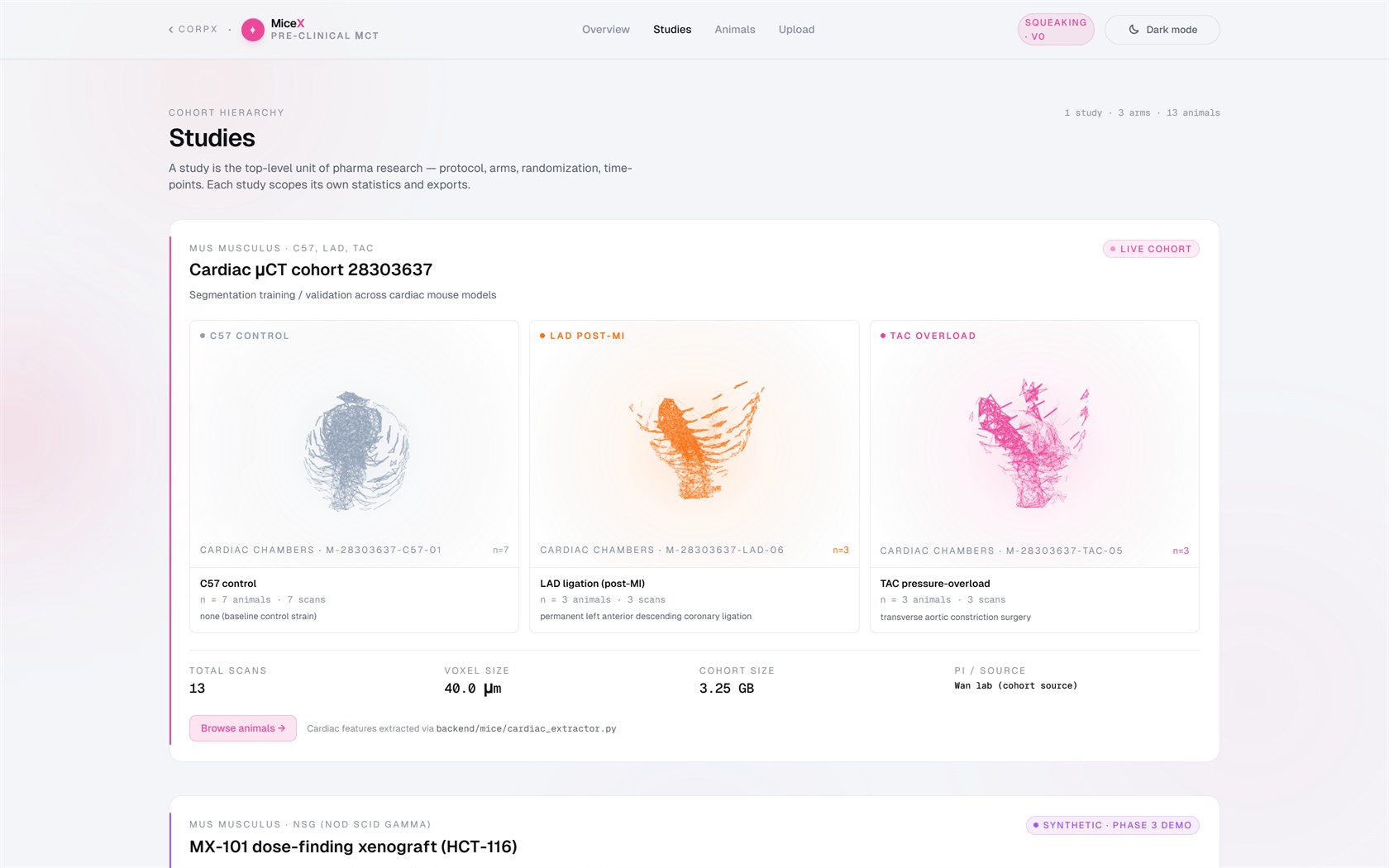
01 · Your unit of analysis
Built around how a study is actually run.
A clinical imaging tool hands you one patient at a time, because that is all a clinic needs. A study is not a stack of patients. It is arms, randomisation, time-points and a comparison you specified before the first scan. MiceX is built on that shape — every measurement lands in a study, in an arm, on an animal, at a time-point, and rolls up without anyone rebuilding the spreadsheet.
02 · What it measures
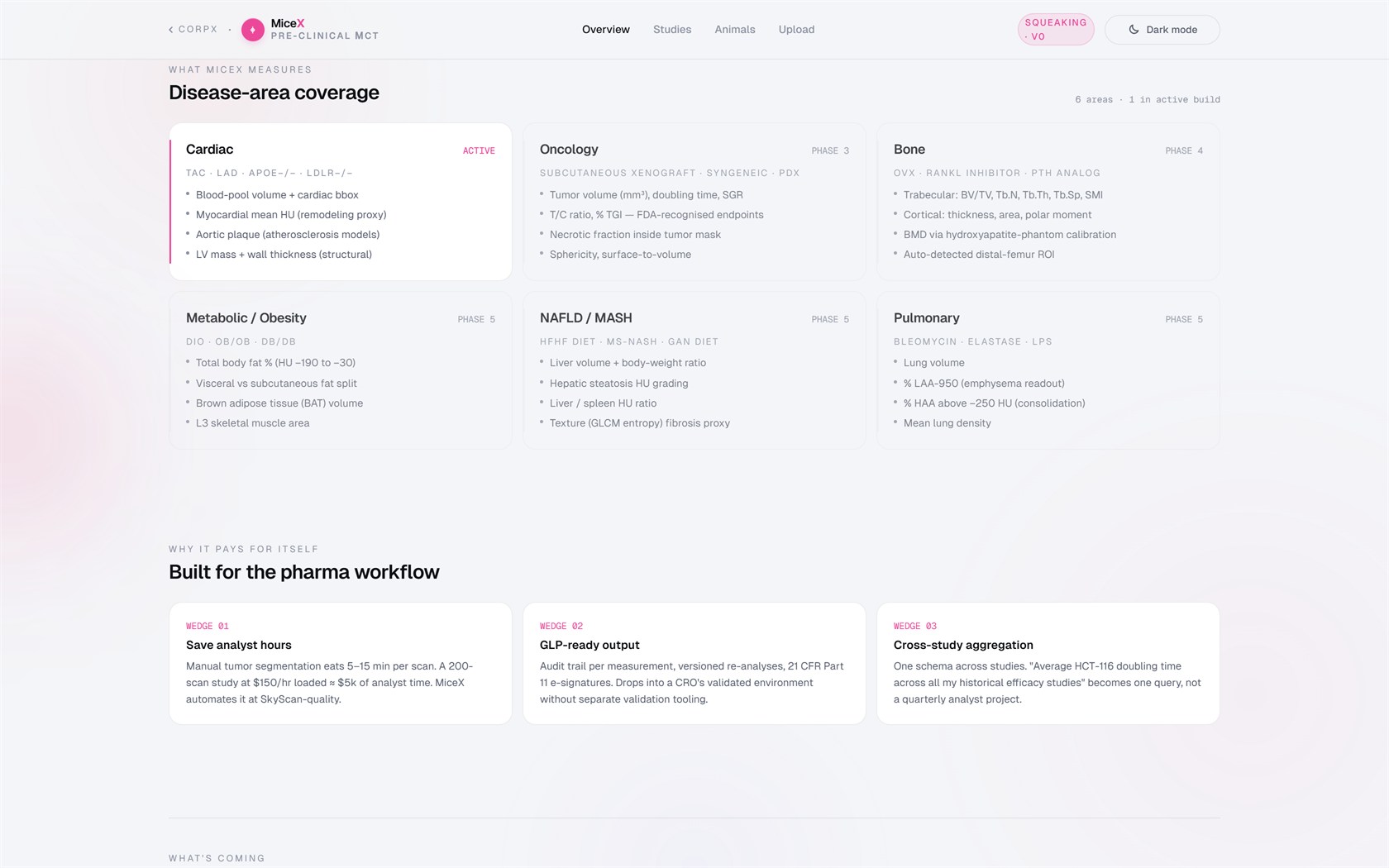
Six disease areas, measured from the voxels.
Cardiac is in active build. The other five carry a phase number rather than a ship date — each one a specification with a measurement set attached, not a claim about today.
03 · What it costs you today
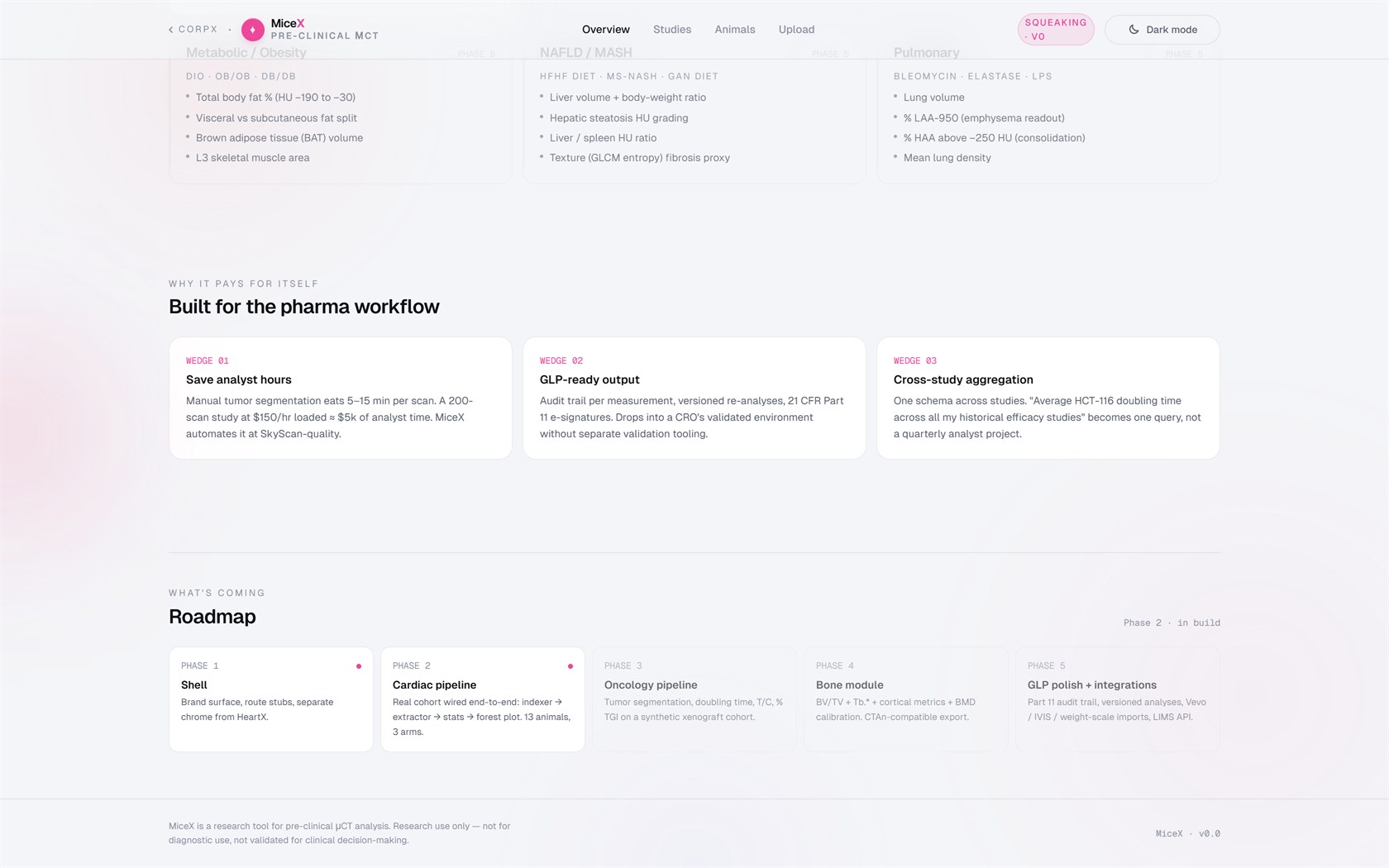
The measurement is not the expensive part. The analyst is.
Manual segmentation
5–15 min
per tumour, per scan, by hand.
A 200-scan study
≈ $5,000
of analyst time at $150/hr loaded.
MiceX
Scanner pace
the same segmentation, at scanner throughput.
“Average HCT-116 doubling time across all my historical efficacy studies” becomes one query, not a quarterly analyst project.
04 · Endpoints, and how we prove them
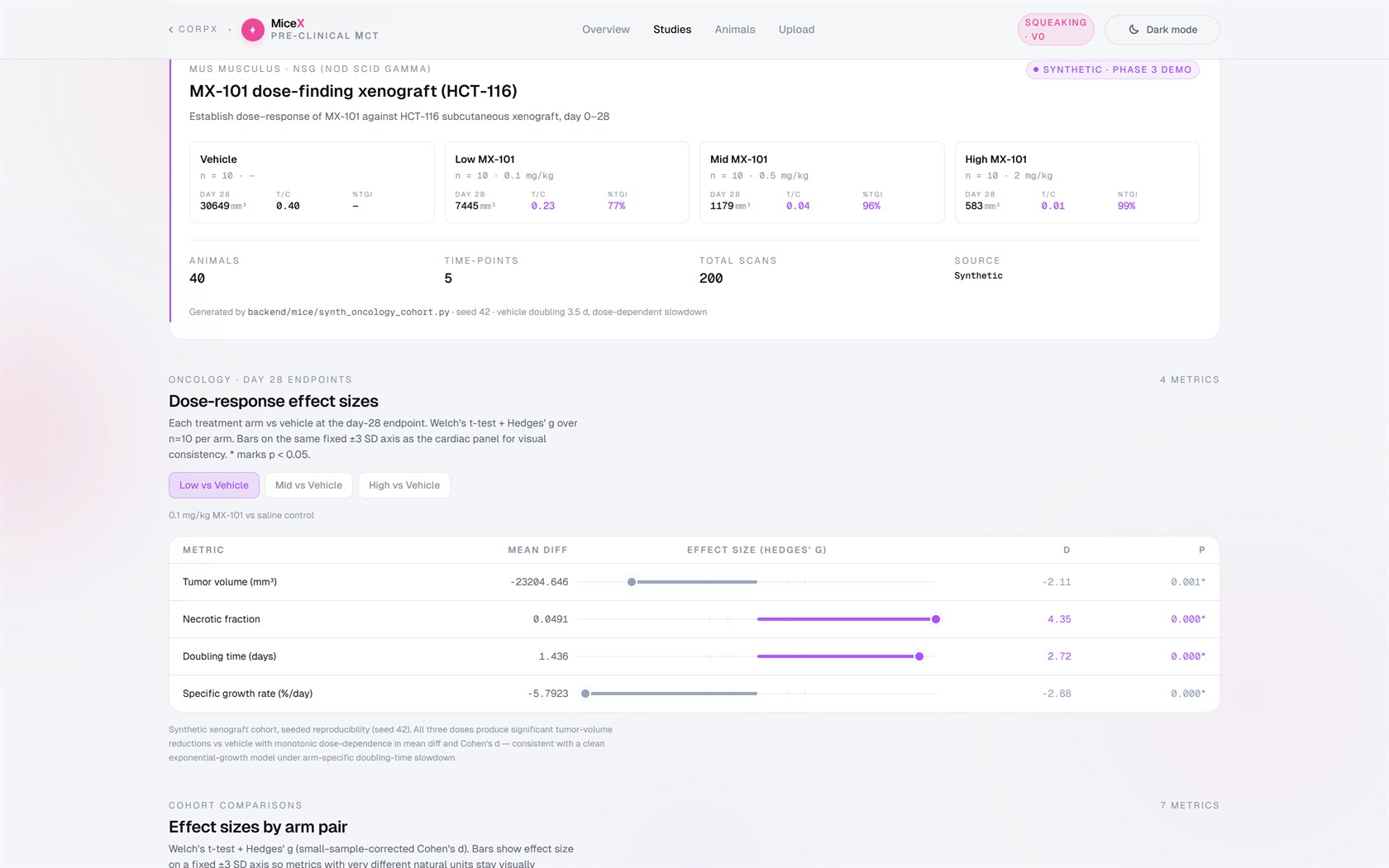
We generate the cohort where the answer is known, then check we recover it.
Before real oncology data exists, the pipeline runs against a synthetic xenograft cohort built with the dose–response written in — vehicle, low, mid, high, a known doubling time, a known slowdown per arm. The endpoints it produces have to come back matching what was built in. This is the Prove stage of the loop, pointed at a module before its data arrives.
05 · What’s real today
Where this module actually is.
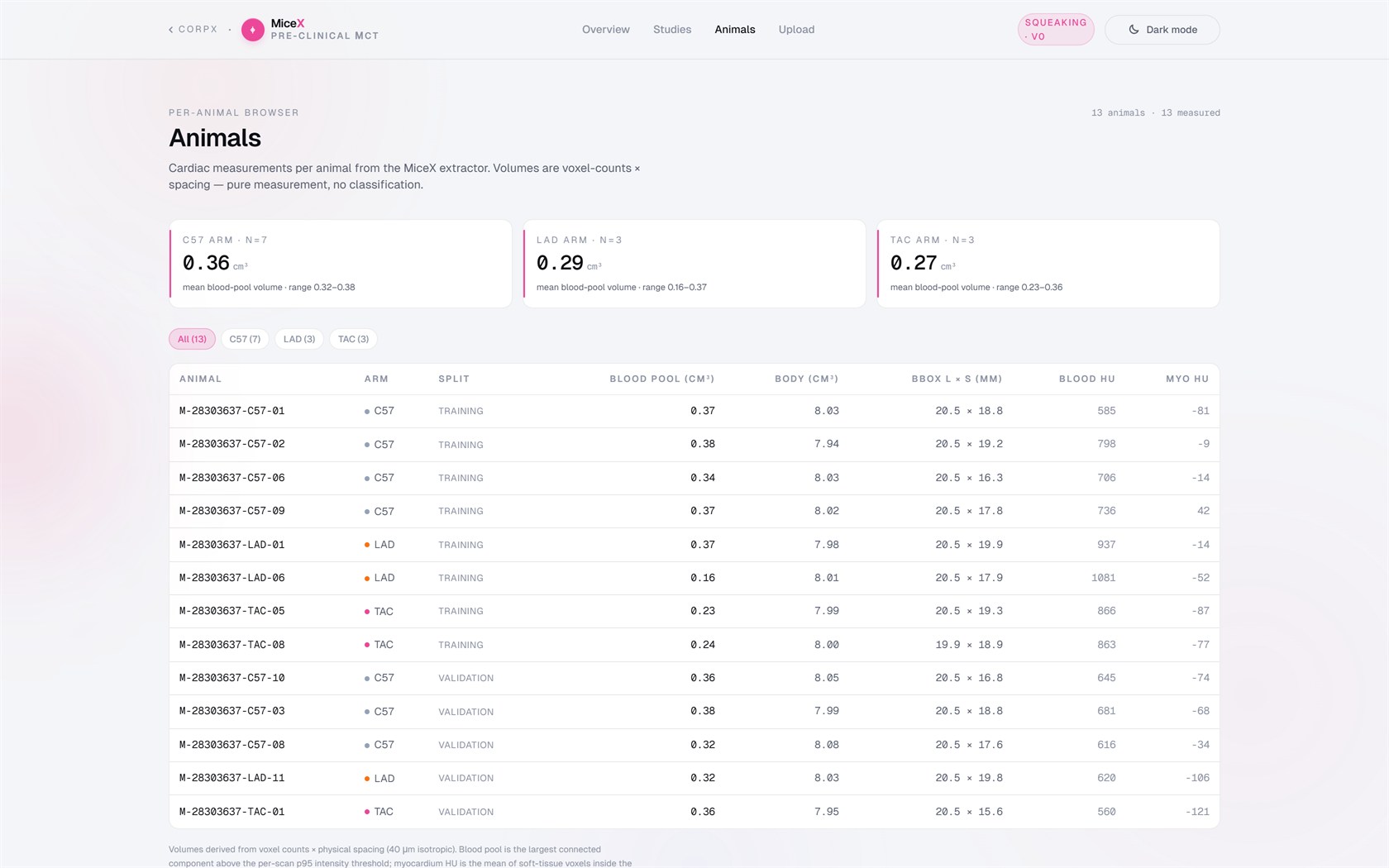
Cardiac pipeline end to end — 13 animals, 3 arms, real µCT at 40 µm
Study / arm / animal / time-point model
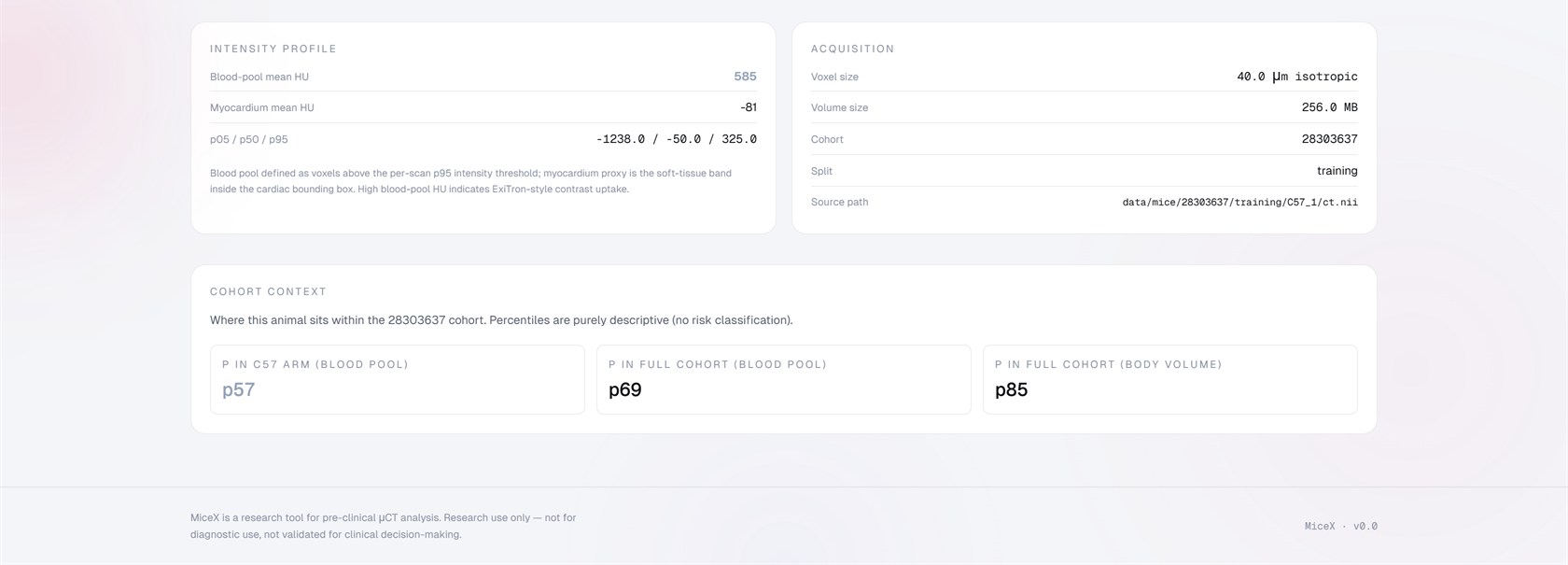
Per-animal measurement with cohort percentiles
Structured export with provenance
Oncology pipeline on real data (synthetic cohort today)
Bone, metabolic, NAFLD/MASH and pulmonary measurement sets
Pre-clinical intake — scanner-native import
Audit trail, versioned re-analyses, LIMS integration
Cardiac is wired end to end. Everything else has a specification and a place in the queue. We would rather show you the queue than the mockup.
06 · What you receive
Every animal, with its record attached.
07 · Who it’s for
Pharma drug discovery
Efficacy studies where the imaging endpoint is the readout and the analyst queue is the bottleneck.
Pre-clinical CROs
The same measurement across every sponsor’s study, with the record attached.
08 · Request access
Tell us what your study measures.
Model, arms and time-points — we will tell you plainly what MiceX measures today and what is still in the queue.